


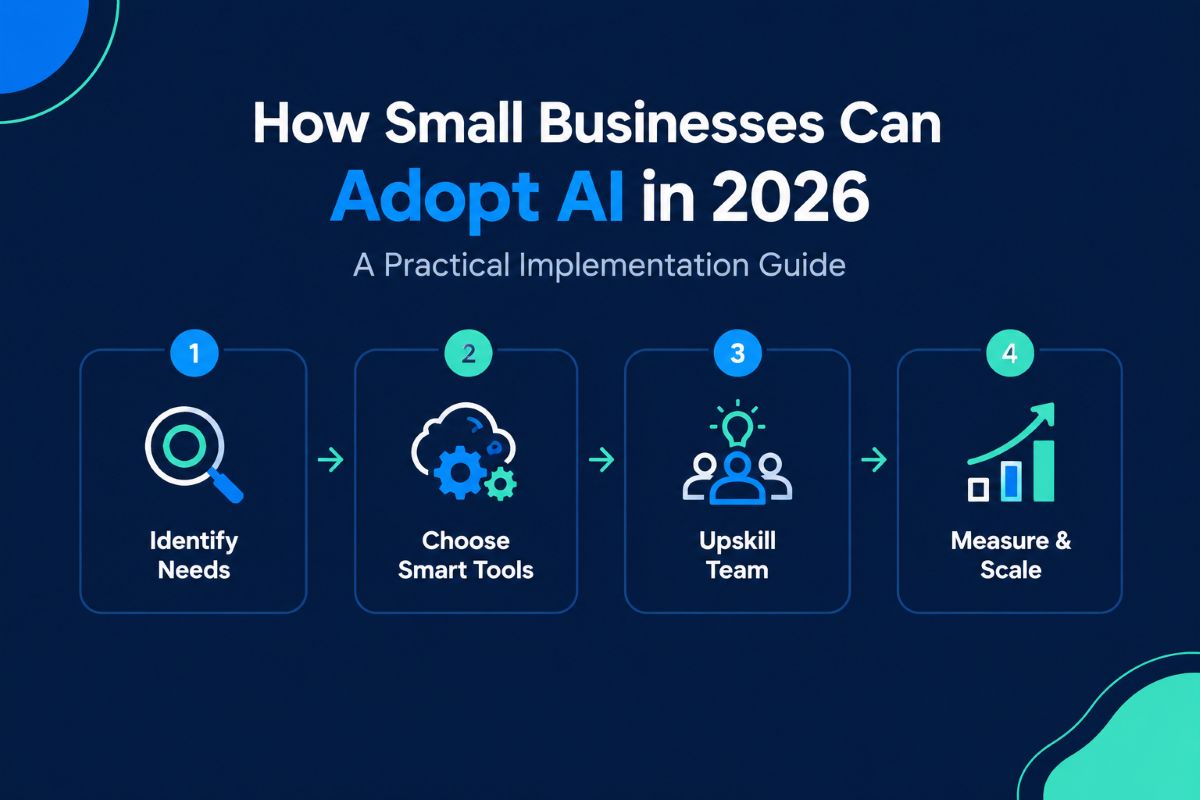
AI is becoming easier for small businesses to access, but buying a tool is not the same as putting it to work. The most useful approach is to start with one business problem, test a suitable AI tool on a limited scale, and expand only when the results are clear.
For a small business, AI can support everyday work such as drafting customer emails, preparing marketing content, summarising documents, analysing sales data, and handling routine enquiries. The goal is not to automate everything. It is to reduce repetitive work while keeping people responsible for decisions, customer relationships and quality.
This guide explains how to choose a practical use case, select tools, protect business information and build a manageable AI implementation plan for 2026.
Why Small Businesses Are Adopting AI in 2026
AI adoption is moving beyond experimentation, although many businesses are still learning how to integrate it into daily operations.
A government survey published in 2026 reported that 32% of businesses were using at least one AI technology, up from 16% in 2025. Among businesses using or planning to use AI, common applications included administration, marketing and IT support. The figures cover businesses of different sizes, so they should not be treated as a small-business-only adoption rate.
For smaller firms, the appeal is practical. AI may help a business:
- Reduce time spent on repetitive administrative tasks
- Draft and adapt marketing content
- Respond to common customer questions
- Organise information from documents and conversations
- Support basic analysis of sales or customer feedback
- Help employees complete certain tasks more consistently
These benefits are not automatic. Results depend on the task, the quality of the information provided, the tool selected and the amount of human review required.
1. Start With a Business Problem, Not an AI Tool
The first step in adopting AI is to identify a task that takes time, creates a bottleneck or produces avoidable errors.
Do not begin by asking, “Which AI tool should we buy?” Instead, ask, “Which part of our work could be improved, and how would we know?”
A useful starting point is to list recurring tasks across the business:
| Business function | Possible AI use |
|---|---|
| Marketing | Drafting campaign ideas, social posts and email variations |
| Customer service | Preparing responses to routine enquiries |
| Administration | Summarising meetings and organising notes |
| Sales | Drafting follow-ups and summarising customer conversations |
| Finance | Categorising information or explaining trends for review |
| Operations | Creating checklists and summarising process documents |
| Human resources | Drafting job descriptions and onboarding materials |
Choose a task that is frequent, clearly defined and relatively low risk. Drafting an internal meeting summary is usually easier to test safely than allowing AI to make decisions about hiring, payments or customer eligibility.
2. Choose a Suitable AI Tool
Small businesses do not always need a custom AI system. Many can begin with tools that already include AI features or with general-purpose assistants.
General-purpose AI assistants
Tools such as ChatGPT, Google Gemini and Microsoft Copilot can help with drafting, summarising, brainstorming and analysing information. They are useful for testing ideas before investing in a more specialised system.
AI features in existing software
Accounting, email, customer relationship management, design, and project management platforms may offer AI features within their existing products.
Starting with software your team already uses can reduce the effort involved in introducing a new tool. However, check which features are included in your current plan and whether additional charges apply.
Purpose-built AI tools
Specialised tools may be useful for tasks such as transcription, customer support, document processing or sales analysis. They can offer a closer fit for a particular workflow, but may require more setup or integration.
Custom AI applications and agents
A custom application or AI agent may be appropriate when a business has a repeatable workflow that cannot be handled well by an off-the-shelf product.
For most small businesses, this should come later. First confirm that the process is stable, the data is suitable, and the expected benefit justifies the extra cost and maintenance.
3. Run a Small, Measurable Pilot
A pilot lets you test AI on real work without making it responsible for an entire business process.
A practical pilot can follow these steps:
- Choose one task. Define exactly what the AI will help with.
- Record the current process. Note how long it takes and where errors or delays occur.
- Set a success measure. This might be time saved, fewer revisions, faster responses or improved consistency.
- Select a small test group. Include the people who actually perform the task.
- Test representative examples. Use normal cases as well as unusual or difficult ones.
- Review the results. Compare AI-assisted work with the existing process.
- Decide whether to continue. Improve, expand or stop based on the evidence.
For example, a small online retailer could test AI-assisted product-description drafting on a limited set of products. Staff would check accuracy, tone, search relevance and editing time before deciding whether to use the process more widely.
The key is to measure the complete workflow. Faster first drafts may not create a benefit if checking and correcting them takes longer than writing from scratch.
4. Prepare Your Data and Protect Business Information
AI tools are only as useful as the information they receive. Before introducing AI into a workflow, check whether the relevant documents, records and instructions are accurate, current and accessible to the right people.
A basic preparation checklist includes:
- Remove duplicate or outdated documents where possible.
- Identify which information is confidential or personal.
- Confirm who is allowed to access the source data.
- Decide which information may be entered into an AI tool.
- Check the provider’s privacy, security, retention and data-use terms.
- Keep important business records in their approved systems rather than relying on chat histories.
Small businesses should establish simple rules for staff use. For example, employees may be allowed to use an approved assistant to rewrite a public product description but prohibited from entering customer payment details or confidential employee records.
The Australian Cyber Security Centre’s 2026 small-business guidance highlights risks including data leaks, privacy breaches, unreliable outputs and vulnerabilities involving third-party services. It recommends setting rules for AI use and reviewing vendors’ security and data-handling practices.
5. Keep Human Review in the Workflow
AI can produce incorrect information, misunderstand context or present an uncertain answer with confidence. Human review is therefore essential, especially when the output affects customers, money, legal obligations or business reputation.
Decide in advance which tasks AI can:
- Draft: Create a first version for a person to review.
- Recommend: Suggest options without making the final decision.
- Assist: Complete part of a workflow while a person checks the result.
- Automate: Perform a narrow, low-risk task under defined rules and monitoring.
For example, an AI assistant might draft a response to a customer complaint. A staff member should review the facts, tone and proposed remedy before sending it.
The NIST Generative AI Profile guides identifying and managing risks across the use of generative AI. Small businesses do not need to adopt a complex enterprise programme to benefit from its basic principles: understand the use, identify possible harms, test performance and assign responsibility.
6. Train Employees and Set Clear Rules
AI adoption works best when employees understand what the tool is for and how to use it safely.
Training does not have to be lengthy. It can include short demonstrations, approved examples and a simple written policy.
Your AI use policy should explain:
- Which tools are approved
- What information must not be entered
- Which outputs require review
- Who can approve new tools or integrations
- How staff should report errors or concerns
- Who is responsible for monitoring the workflow
Give employees time to practise with realistic tasks. Encourage them to report where AI saves time and where it creates extra work. Their feedback can help identify better use cases and prevent unofficial, unmanaged tool use.
7. Calculate the Real Cost and Return
AI costs can include more than the monthly subscription. Consider setup, training, integration, staff review, maintenance and the time needed to correct mistakes.
A simple calculation can help:
Estimated monthly value = time saved × hourly labour cost − monthly AI and implementation costs
This is an estimate, not a guarantee of financial return. Time saved may be used for other productive work rather than reducing payroll costs.
Track more than speed. Depending on the task, useful measures may include:
- Time required to complete the work
- Error or revision rate
- Customer response time
- Employee adoption
- Customer satisfaction
- Cost per completed task
If the tool does not improve the outcome enough to justify its full cost, change the workflow or stop using it.
8. A Practical 30-Day AI Adoption Plan
A small business can use the first month to move from an idea to a controlled pilot.
| Period | Action | Expected result |
|---|---|---|
| Week 1 | Identify a repetitive task and record the current process | Clear use case and baseline |
| Week 2 | Compare suitable tools, check data and establish rules | Tool selected with basic safeguards |
| Week 3 | Test the tool with a small group and review outputs | Evidence from real work |
| Week 4 | Measure results and decide whether to expand | Documented go/no-go decision |
This is a starting framework, not a fixed timeline. A workflow involving sensitive information or complex integrations may need more time.
Common AI Adoption Mistakes to Avoid
Small businesses can reduce wasted effort by avoiding a few common mistakes:
- Buying too many tools at once: Start with one use case and expand only when there is a clear reason.
- Expecting immediate transformation: Early benefits may be incremental, and workflows often need adjustment.
- Using AI without clear ownership: Assign someone to approve tools, review performance and manage access.
- Skipping staff training: A tool is unlikely to help if employees do not understand how to use it.
- Trusting outputs without checking: Verify facts, calculations, customer details and important recommendations.
- Automating a broken process: Improve the workflow first; AI may otherwise make existing problems happen faster.
- Ignoring ongoing maintenance: Review performance, costs, permissions and vendor changes after launch.
Frequently Asked Questions
What is the best way for a small business to start using AI?
Start with one repetitive, low-risk task that takes time or creates delays. Test an appropriate tool, measure the results and expand only if it improves the workflow.
How much does AI cost for a small business?
Costs vary by tool, plan, number of users, usage limits and integration needs. Some AI features may be included in existing software, while specialised tools or custom systems can involve additional subscription and implementation costs. Check current pricing before committing.
Can AI replace employees in a small business?
AI is better treated as a way to assist with specific tasks than as a blanket replacement for employees. People remain important for judgment, customer relationships, quality control and responsibility for business decisions.
Is AI safe for small businesses to use?
It can be used more safely when the business chooses reputable providers, limits access to sensitive information, establishes clear rules and checks outputs. No tool is risk-free, so safeguards should match the task and the information involved.
Should a small business build its own AI system?
Usually, it is sensible to test existing tools first. A custom system may be worth considering when a business has a stable, valuable workflow that off-the-shelf tools cannot handle effectively and the business can support its ongoing maintenance.
Final Takeaway
The most effective way to adopt AI in a small business in 2026 is to start small, focus on a real operational need and measure the result. Choose a suitable tool, prepare the data, train the people who will use it and keep human oversight where it matters.
AI should earn its place in the business through better work, not simply because it is new. A well-tested improvement to one everyday process is a stronger starting point than a large, expensive rollout without a clear purpose.
